Class 7 English Worksheet on Persuasive Conclusions
Class 7EnglishEnglish GrammarFree DownloadPDF

Anshika JainVisit Profile
I am an enthusiastic educator and communication mentor dedicated to helping students build confidence and strong language skills. I am having teaching experience of over 6 years and 2 years in PlanetSpark. I work as a Public Speaking, Creative Writing, English, and Phonetics mentor at PlanetSpark and also teach the CBSE curriculum through private virtual classes. With a student-centered teaching approach, I focus on improving communication abilities, creative thinking, and language proficiency to help learners express their ideas clearly and confidently.
Class 7 English Worksheet on Persuasive Conclusions
Class 7EnglishEnglish GrammarFree DownloadPDF
Anshika JainVisit Profile
I am an enthusiastic educator and communication mentor dedicated to helping students build confidence and strong language skills. I am having teaching experience of over 6 years and 2 years in PlanetSpark. I work as a Public Speaking, Creative Writing, English, and Phonetics mentor at PlanetSpark and also teach the CBSE curriculum through private virtual classes. With a student-centered teaching approach, I focus on improving communication abilities, creative thinking, and language proficiency to help learners express their ideas clearly and confidently.
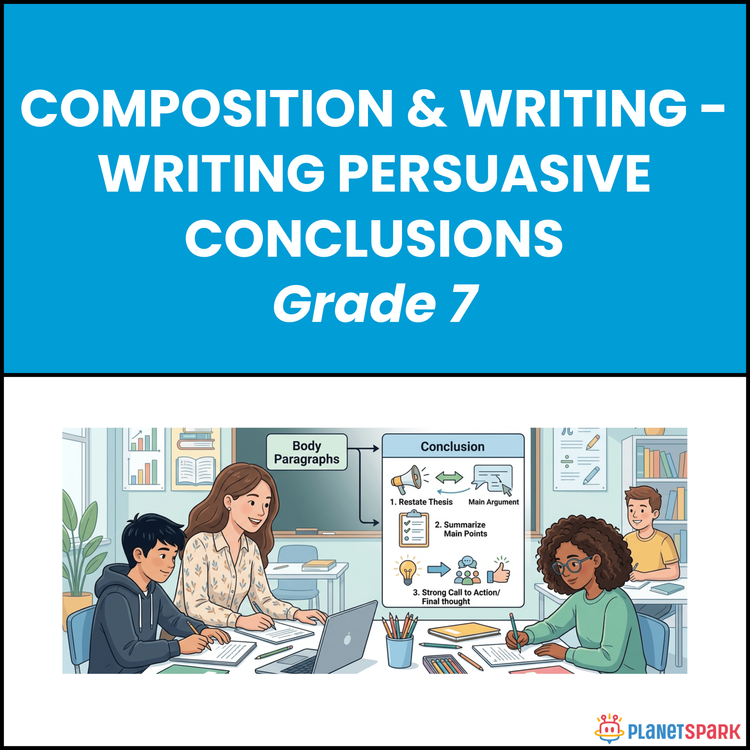
Ending with Impact: Persuasive Conclusions for Class 7
This Grade 7 English worksheet focuses on the skill of writing strong persuasive conclusions. Centered around an engaging story set in the Silent Caves of Nashik, students explore how powerful endings can influence thoughts, emotions, and actions. The worksheet combines reading comprehension with grammar-based application to help learners understand the structure and purpose of effective conclusions.
Through a variety of exercises such as multiple-choice questions, fill in the blanks, true or false, error identification, and paragraph completion, students learn how to identify strong endings, analyze persuasive techniques, and apply them in context. Each activity is designed to strengthen critical thinking, reading skills, and writing clarity in an age-appropriate and engaging manner.
Why Persuasive Conclusions Matter in Grammar?
Persuasive conclusions are essential in shaping how ideas are remembered and acted upon. For Grade 7 learners, this topic is important because:
1. Conclusions reinforce the main idea of a passage or argument.
2. They encourage the reader or listener to take action or reflect deeply.
3. Strong endings create emotional and logical impact.
4. They are key components in essays, speeches, and real-life communication.
What’s Inside This Worksheet?
This worksheet includes five engaging exercises that build understanding of persuasive conclusions:
Exercise 1 – Multiple Choice Questions
Students read the story and select the correct answers based on comprehension and inference skills.
Exercise 2 – Fill in the Blanks
Students choose suitable words from the word bank to complete sentences related to the story.
Exercise 3 – True or False
Students evaluate statements and decide whether they correctly reflect the story.
Exercise 4 – Underline the Incorrect Word
Students identify and underline the word that does not match the meaning or story context.
Exercise 5 – Paragraph Completion
Students complete a paragraph using appropriate words based on their understanding of the story.
Answer Key (For Parents & Educators)
Exercise 1 – Multiple Choice
1. b) A hidden map
2. c) It ended weakly without a strong final push
3. a) It combined reasons with urgent action
4. b) Mind-opening tools
5. c) To show future consequences
6. d) Speakers must face responsibility
7. a) Therefore, we must act today to protect what still can be saved.
8. b) Parv
9. a) A strong conclusion can move readers toward action.
10. c) The cave grew colder before Raman spoke.
Exercise 2 – Fill in the Blanks
1. conclusion
2. reason
3. regret
4. persuade
5. action
6. readers
7. guide
8. powerful
9. final
10. forward
Exercise 3 – True / False
1. True
2. False
3. True
4. False
5. True
6. True
7. True
8. False
9. False
10. True
Exercise 4 – Underline the Incorrect Word
1. sleepy- motivated
2. detailed- weak
3. museum- garden
4. kitchen- library5. future- warned about
6. beginning- conclusion
7. unrelated- connected
8. forgetfulness- reflection
9. interest- resolve
10. ticket- notebook
Exercise 5 – Paragraph Completion
discovery, conclusion, reason, readers, regret, responsibility, powerful, forward
Help your child master persuasive writing and craft impactful conclusions with confidence through guided practice and expert support.
Frequently Asked Questions
"A persuasive conclusion is the final part of a piece that reinforces the main idea and leaves a strong impression on the reader.
The conclusion helps remind the reader of the key points and encourages them to agree with the writer’s opinion.
Students can use strong words, ask a thought-provoking question, or give a clear final message to leave a lasting effect.