Class 7 Worksheet on Recurring Symbols & Motifs
Class 7EnglishEnglish GrammarFree DownloadPDF

Abshar AfrozVisit Profile
I am an enthusiastic English educator with a strong passion for helping students develop confidence in communication. At Planet Spark, I specialize in teaching Public Speaking and Creative Writing, guiding learners to express themselves clearly, think creatively, and speak with impact. Drawing on my teaching experience and warm, engaging style, I help children develop fluent English, powerful presentation skills, and a love for writing. My sessions are interactive, skill-focused, and designed to build both language proficiency and self-confidence in young minds.
Class 7 Worksheet on Recurring Symbols & Motifs
Class 7EnglishEnglish GrammarFree DownloadPDF
Abshar AfrozVisit Profile
I am an enthusiastic English educator with a strong passion for helping students develop confidence in communication. At Planet Spark, I specialize in teaching Public Speaking and Creative Writing, guiding learners to express themselves clearly, think creatively, and speak with impact. Drawing on my teaching experience and warm, engaging style, I help children develop fluent English, powerful presentation skills, and a love for writing. My sessions are interactive, skill-focused, and designed to build both language proficiency and self-confidence in young minds.
Hidden Patterns, Bigger Meanings: Recurring Symbols & Motifs for Class 7
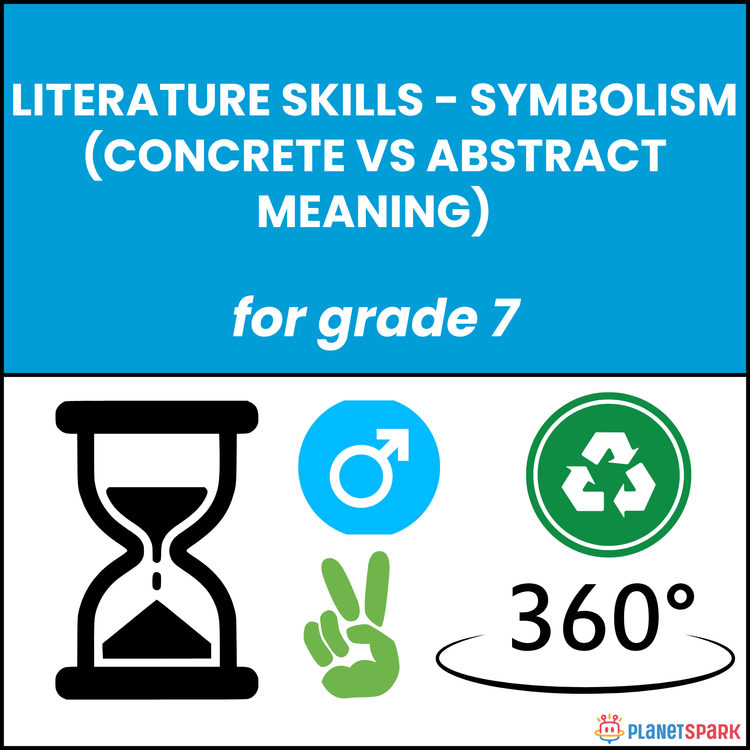
This Grade 7 literature worksheet sharpens your child’s ability to spot recurring symbols and motifs in stories, poems, and novels. Motifs are repeated images, colours, sounds, words, or ideas that help reveal a story’s deeper message. Through five engaging tasks — multiple choice questions, fill in the blanks, true or false, underlining repeating elements, and paragraph writing — students learn to move beyond basic plot details and become alert, analytical readers.
Why Recurring Symbols & Motifs Matter in Literature?
Motifs are not accidents. They are powerful tools authors use to reinforce themes and guide readers’ emotions. For Class 7 learners, understanding motifs is important because:
1. A motif can be an object (feathers), a colour (green for jealousy), a sound (thunder), or a repeated phrase (“remember”).
2. Recognising motifs helps readers predict events and understand character feelings.
3. One story may contain multiple motifs working together to support a central theme.
4. Noticing repetition builds critical thinking and prepares students for advanced literary analysis.
What’s Inside This Worksheet?
This worksheet contains five literature-based activities that strengthen motif recognition:
📖 Exercise 1 – Multiple Choice Questions
Students choose the correct answer from four options. Questions cover basic definitions of motif, examples (colour, sound, phrase), and how motifs differ from one‑time symbols.
📝 Exercise 2 – Fill in the Blanks
Using a word bank (motif, recurring, symbol, theme, pattern, attention, author, meaning, image, phrase), students complete sentences that reinforce key vocabulary and concepts about repetition in texts.
✅ Exercise 3 – True and False
Ten statements test understanding of motif vs symbol, repeated images, sounds as motifs, and the purpose of noticing repetition. This clears common misconceptions.
✍️ Exercise 4 – Underline the Words
Students read ten short examples and underline the repeated element that functions as a motif — from crow sounds and stopped wind to feathers, the word “remember”, water dreams, bells, fog, red colour, and flickering candles.
📄 Exercise 5 – Paragraph Writing with Blanks
A complete paragraph about motifs is presented with missing words. Students fill each blank using their understanding of motif-related terms, reinforcing how authors weave meaning through repetition.
🔖 Answer Key
Exercise 1 – Multiple Choice Questions
1. a) motif
2. a) phrase
3. b) motif
4. a) theme
5. c) thunder
6. c) motif
7. a) jealousy
8. b) message
9. c) action
10. a) cleansing
Exercise 2 – Fill in the Blanks
1. motif
2. meaning
3. image
4. symbol
5. phrase
6. theme
7. author
8. attention
9. recurring
10. pattern
Exercise 3 – True and False
1. False
2. True
3. True
4. False
5. True
6. False
7. True
8. True
9. False
10. True
Exercise 4 – Underline the Words
Every time Riya lied, a crow cawed outside her window.
Underlined: crow — Circled: Riya's dishonesty
Whenever danger approached, the wind suddenly stopped blowing completely.
Underlined: wind — Circled: approaching danger
Raj found feathers on the ground before each important victory in his life.
Underlined: feathers — Circled: upcoming success
The word "remember" was spoken by a different character in each chapter.
Underlined: remember — Circled: the importance of memory or reflection
Ravi dreamed of water in every chapter before making a big decision.
Underlined: water — Circled: the need for clarity or decision-making
The clock stopped at midnight in three different chapters of the novel.
Underlined: clock — Circled: moments of significance or change
Meera heard a bell ring each time a character told the truth.
Underlined: bell — Circled: truth or honesty
Fog rolled in during every scene where a character felt confused or lost.
Underlined: fog — Circled: confusion or uncertainty
The colour red appeared on every page where violence was about to happen.
Underlined: red — Circled: impending violence
A single candle flickered in every scene where hope was nearly gone.
Underlined: candle — Circled: dwindling hope
Exercise 5 – Paragraph Writing with Blanks
A motif is a symbol or idea that repeats throughout a story. Unlike a one‑time symbol, a motif appears many times. A motif can be an image, a sound, a colour, or a repeated phrase. For example, a story might have a motif of birds. Every time a character feels free, a bird appears. Another story might have a motif of thunder. Every time a character lies, thunder crashes. A motif helps develop the story's theme. The repetition creates a pattern. It teaches the reader to pay attention. When you notice a motif, ask yourself what it means each time it appears. Does the meaning change? Does it stay the same? The author uses motifs to send a message without stating it directly. Finding motifs makes you a more thoughtful and analytical reader.
Help your child read between the lines and discover hidden story meanings with a Free 1:1 Communication Skills Trial Class at Planet Spark.
🔖Book a free trial!
Frequently Asked Questions
Recurring symbols and motifs are repeated elements that have significant meaning and help reinforce the themes of the story.
Recognizing patterns in symbols and motifs helps readers uncover the story's central ideas and understand the author's message more clearly.
Yes, symbols and motifs may evolve or take on new meanings as the plot progresses, reflecting character growth or thematic shifts.