Class 7 Worksheet on Cause and Effect Vocabulary
Class 7Free DownloadPDF

Arzoo KhanVisit Profile
I’m a friendly and dedicated English teacher who helps children learn with confidence and ease. I create a comfortable and supportive environment where students are not afraid to make mistakes and are encouraged to believe in themselves.
Class 7 Worksheet on Cause and Effect Vocabulary
Class 7Free DownloadPDF
Arzoo KhanVisit Profile
I’m a friendly and dedicated English teacher who helps children learn with confidence and ease. I create a comfortable and supportive environment where students are not afraid to make mistakes and are encouraged to believe in themselves.
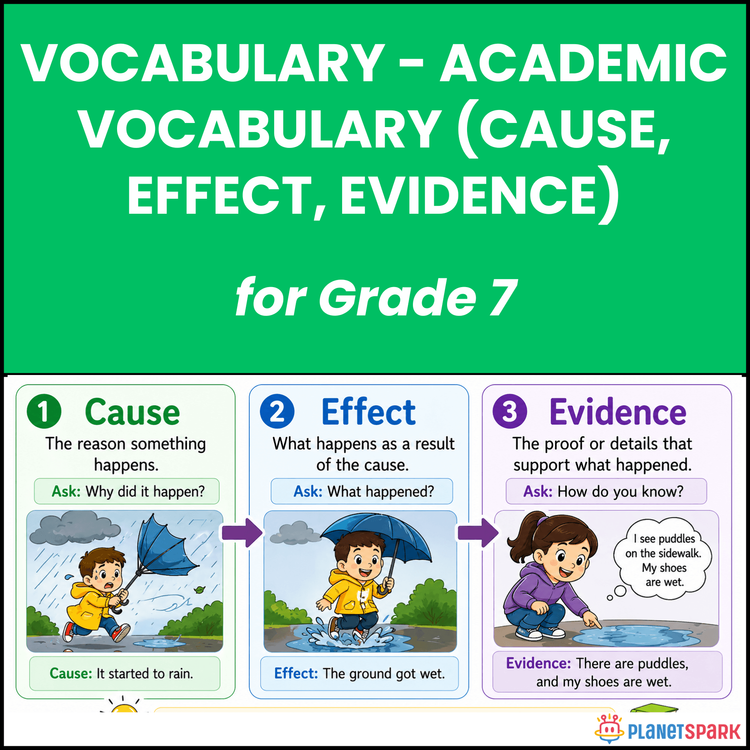
Understand Why Things Happen: Cause, Effect & Evidence Vocabulary for Class 7
This Grade 7 worksheet focuses on academic vocabulary related to cause, effect, and evidence—core concepts that help students explain why something happens, what results from it, and how ideas are supported. Learners work with connectors like “because,” “therefore,” “due to,” and “as a result” to build logical relationships between ideas and strengthen their reasoning skills.
Why Cause, Effect & Evidence Matter in Grammar?
This topic is not just about vocabulary—it’s about logical thinking and clarity in expression. For Grade 7 learners, this is important because:
1. It helps students understand relationships between actions and outcomes.
2. It improves structured writing using logical connectors.
3. It builds the ability to support ideas with evidence.
4. It strengthens reasoning in both academic and real-life contexts.
What’s Inside This Worksheet?
This worksheet includes five structured exercises designed to build clarity and application:
🧠 Exercise 1 – True or False
Students evaluate statements about cause, effect, and evidence, identifying correct definitions and common misconceptions (page 3).
✏️ Exercise 2 – Sort the Words
Learners classify connectors into cause and effect categories:
📋 Exercise 3 – Fill in the Blanks
Students choose the correct connector from given pairs to complete sentences logically, applying cause-effect relationships in context (page 5).
📝 Exercise 4 – Multiple Choice Questions
MCQs test understanding of correct connectors and their usage in forming logical sentences (pages 6–7).
🔁 Exercise 5 – Sentence Rewriting
Students replace incorrect connectors (like “although”) with correct cause-effect connectors such as “because” or “therefore” to fix logical errors (page 8).
✅ Answer Key (For Parents & Educators)
Exercise 1 – True or False
1. False
2. False
3. True
4. False
5. True
6. True
7. True
8. False
9. True
10. False
Exercise 2 – Sort the Words
Cause Words:
- because
- since
- due to
- because of
- owing to
- as
- for this reason
Effect Words:
- therefore
- so
- thus
- hence
- consequently
- accordingly
- as a result
- as a consequence
Exercise 3 – Fill in the Blanks
1. so
2. due to
3. therefore
4. consequently
5. so
6. hence
7. owing to
8. thus
9. accordingly
10. so
Exercise 4 – Multiple Choice Questions
1. a) owing to
2. a) thus
3. b) due to
4. c) so
5. a) because
6. b) because of
7. b) as a result of
8. c) as
9. d) due to
10. a) because
Exercise 5 – Sentence Rewriting
1. She failed because she did not study.
2. He was late because there was heavy traffic.
3. The match was cancelled because it rained heavily.
4. She studied hard; therefore, she scored high marks.
5. They stayed home because it was raining heavily.
6. He improved because he practiced daily.
7. The plants died because there was no water.
8. She was absent because she was unwell.
9. He became confident because he prepared well.
10. The road was blocked because there was an accident.
Help your child build strong logical thinking and clear expression by mastering cause, effect, and evidence vocabulary.
🔖Book a free trial!
Frequently Asked Questions
They help students understand how events connect, improving logical reading comprehension and stronger writing in Class 7 English practice.
Words like because, therefore, and as a result help children explain reasons and outcomes more clearly in reading tasks.
They can ask children to explain daily events using reason and result sentences, building stronger vocabulary and clearer thinking.