Class 7 English Worksheet on Types of Irony
Class 7EnglishEnglish GrammarFree DownloadPDF

Leena JaryalVisit Profile
I’m a passionate English educator with 15 years of experience teaching across IB, IGCSE, and CBSE boards. I’ve also trained learners in spoken English, public speaking and corporate communication. Currently at PlanetSpark, I love empowering learners to communicate with confidence and clarity.
Class 7 English Worksheet on Types of Irony
Class 7EnglishEnglish GrammarFree DownloadPDF
Leena JaryalVisit Profile
I’m a passionate English educator with 15 years of experience teaching across IB, IGCSE, and CBSE boards. I’ve also trained learners in spoken English, public speaking and corporate communication. Currently at PlanetSpark, I love empowering learners to communicate with confidence and clarity.
Irony (Verbal, Situational, Dramatic) for Grade 7
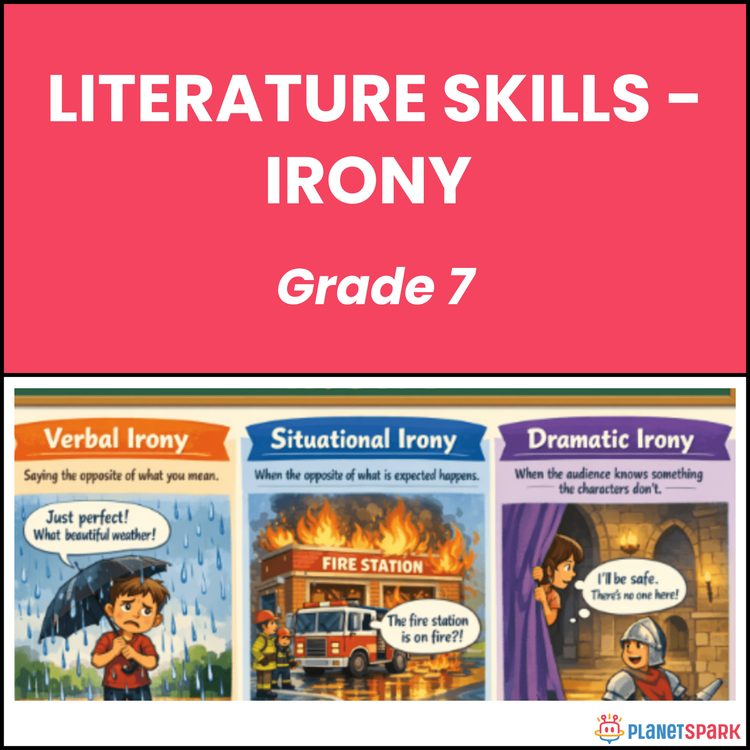
This Grade 7 English worksheet focuses on understanding different types of irony—verbal, situational, and dramatic. It teaches students how irony can add humor, surprise, and depth to stories, making them more engaging. Through exercises such as multiple-choice questions, true/false statements, fill in the blanks, and paragraph writing, students will strengthen their understanding of irony in various contexts.
Why Irony Matters in Literature?
1. Helps students recognize different types of irony in stories.
2. Encourages deeper comprehension by analyzing how irony shapes the plot and characters.
3. Enhances students' ability to write with irony, adding complexity and nuance to their stories.
4. Supports critical thinking and interpretation by exploring the gap between appearance and reality, expectation and outcome.
What’s Inside This Worksheet?
🧠 Exercise 1 – Multiple Choice Questions
Students choose the correct term based on the example provided, identifying verbal, situational, or dramatic irony.
✔️ Exercise 2 – True or False
Students determine whether the given statements about irony are true or false.
✏️ Exercise 3 – Fill in the Blanks
Students complete sentences by filling in the blanks with the appropriate form of irony.
🔍 Exercise 4 – Sentence Underlining
Students read sentences and underline the irony used in each case.
📝 Exercise 5 – Paragraph Writing
Students identify verbal, situational, and dramatic irony within a passage, testing their understanding in context.
Answer Key
Exercise 1 – Multiple Choice
1. a) verbal irony
2. a) situational irony
3. b) dramatic irony
4. a) unexpected outcome
5. c) paradox
6. c) sarcasm
7. a) audience knowledge
8. b) surprise
9. b) expectation
10. c) surprise
Exercise 2 – True or False
1. False
2. False
3. True
4. True
5. False
6. True
7. True
8. True
9. False
10. False
Exercise 3 – Fill in the Blanks
1. contrast
2. verbal
3. expectation
4. unexpected
5. verbal
6. reality
7. hidden
8. surprise
9. outcome
10. audience
Exercise 4 – Sentence Underlining
1. Ironic Situation: "The chef burned the food and proudly served it." — Action Word: "served"
2. Ironic Situation: "The teacher forgot her own homework at home." — Action Word: "forgot"
3. Ironic Situation: "The photographer forgot to bring a camera." — Action Word: "forgot"
4. Ironic Situation: "The tailor wore torn clothes to the show." — Action Word: "wore"
5. Ironic Situation: "The weather reporter got caught in the rain." — Action Word: "caught"
6. Ironic Situation: "The dentist had a mouth full of cavities." — Action Word: "had"
7. Ironic Situation: "The security guard slept during the robbery." — Action Word: "slept"
8. Ironic Situation: "The spelling champion misspelled the word." — Action Word: "misspelled"
9. Ironic Situation: "The librarian lost her favorite book." — Action Word: "lost"
10. Ironic Situation: "The firefighter's house caught fire suddenly." — Action Word: "caught"
Exercise 5 – Paragraph Writing
Verbal Irony: "This is my best performance."
Situational Irony: "Ravi prepared for months for the school quiz and felt confident, but on the day of the quiz he forgot the easiest answers."
Dramatic Irony: "The audience already knew the questions were repeated from last year, but Ravi did not."
Build your child’s understanding of irony and its use in stories today!
Frequently Asked Questions
The main types of irony are verbal irony, situational irony, and dramatic irony, helping Class 7 students understand deeper meanings in stories.
Learning irony helps students recognize hidden meanings and improves comprehension skills in CBSE English lessons.
Early learners can identify irony by comparing expectations with actual outcomes using guided examples in grammar worksheets.